
SignalCards Research
From 183,901 Reddit posts to 495 Opportunity Cards: why I built SignalCards
Turning public Reddit conversations into a source-backed opportunity library — not raw alerts.
SignalCards Research · June 2026 · 7 min read
People complain about broken workflows, expensive tools, confusing migrations, bad support, missing features, and painful workarounds every day.
A lot of those conversations happen in public.
The problem is not that the signals don’t exist.
The problem is that they are buried inside noise.
Reddit is full of market signals, but most of them are mixed with jokes, rants, one-off complaints, self-promotion, generic founder advice, and posts that sound interesting but do not point to a real business opportunity.
That is why I built SignalCards.
SignalCards turns public Reddit conversations into curated, source-backed Opportunity Cards for founders, agencies, consultants, and growth teams.
Not raw alerts.
Not keyword dumps.
Not “here are 500 posts, good luck.”
A SignalCard is meant to answer a more useful question:
Is there a real pain here, who feels it, what are they doing today, which tools are involved, and what could someone build, sell, or test next?
What the SignalCards library includes today
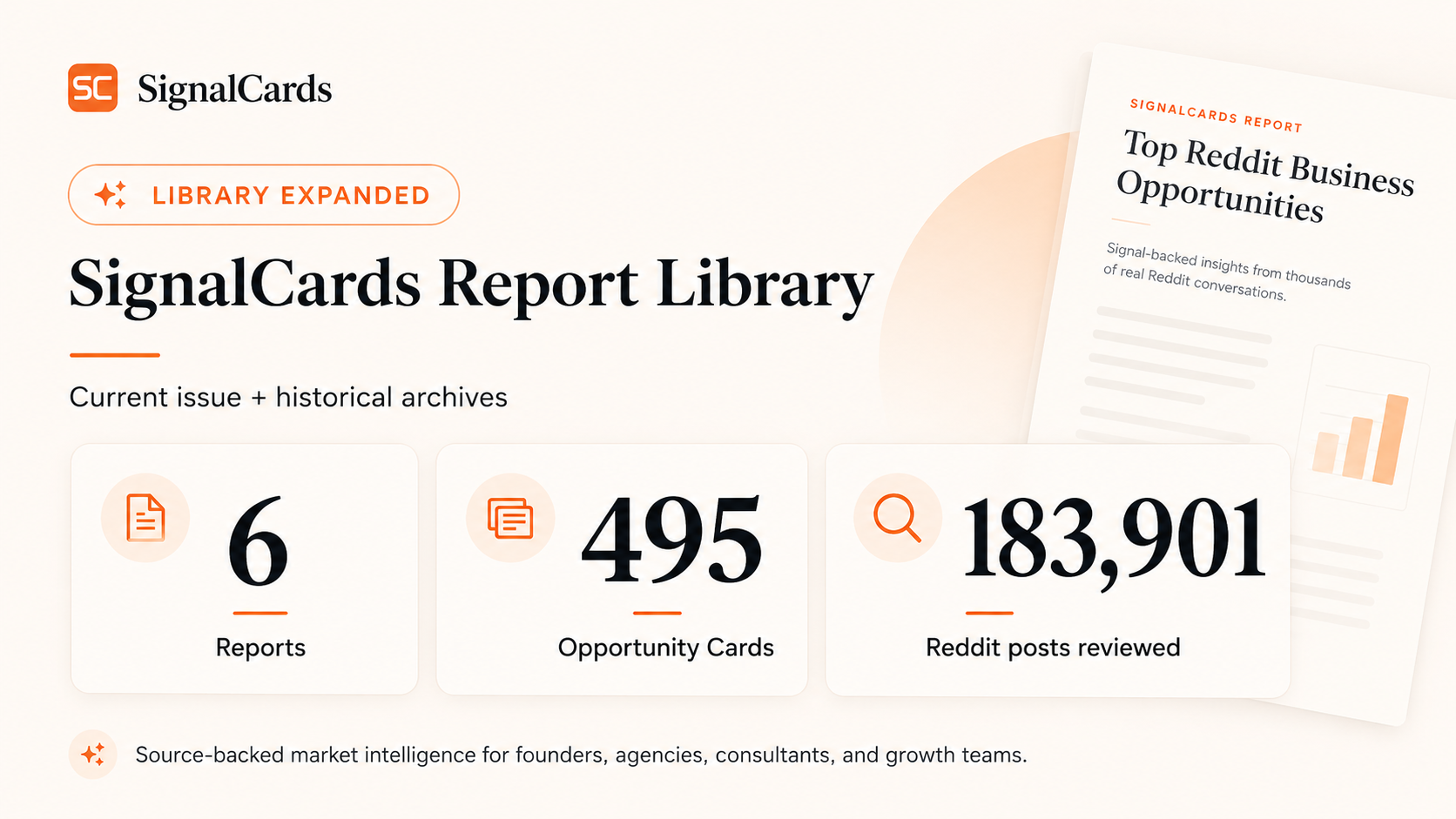
The SignalCards report library now includes:
- 6 reports
- 495 Opportunity Cards
- 183,901 Reddit posts reviewed
The library includes both a current fresh issue and historical archives.
Fresh issues are based on recent research windows. They help surface what people are complaining about, replacing, comparing, or trying to solve now.
Historical archives are rebuilt from larger past research windows. They help create context and show how market pains repeat or evolve over time.
The goal is not to publish every signal.
The goal is to curate the strongest ones.
That distinction matters because SignalCards is not trying to be another Reddit scraper.
It is trying to become a source-backed opportunity library.
Why raw Reddit scraping is not enough
A lot of tools in this space are starting to appear.
Many of them do some version of:
- scrape Reddit;
- monitor keywords;
- cluster complaints;
- score posts;
- send alerts;
- suggest places to reply.
That can be useful.
But raw data is not the same as market intelligence.
A list of posts still leaves the hard work to the reader:
- Is this a real pain or just a rant?
- Is anyone paying for a workaround?
- Are people naming tools they want to replace?
- Is the problem repeated by the same type of user?
- Is there a clear buyer or just curiosity?
- Is there an actual opportunity here?
SignalCards focuses on the layer after raw collection: editorial judgment, structuring, and source-backed interpretation.
For each Opportunity Card, the product looks for signals such as:
- recurring pains;
- competitor complaints;
- migration intent;
- product gaps;
- current workarounds;
- buying evidence;
- named tools and alternatives;
- targetable personas;
- possible go-to-market angles.
The goal is to reduce the research burden.
A founder, agency, consultant, or growth team should be able to open a report and quickly understand what people are struggling with, which tools are being replaced, where migration intent is appearing, and what kind of action might be worth testing.
What an Opportunity Card is
An Opportunity Card is not just a summarized Reddit post.
It is a structured market signal.
A typical card includes:
- the user persona;
- the pain being expressed;
- why it matters;
- why it may be happening now;
- existing alternatives or tools mentioned;
- current workarounds;
- buying evidence;
- suggested action;
- source context when available.
The idea is simple:
Do not just show the complaint. Show the business context around the complaint.
That structure makes it easier to move from “interesting post” to “possible opportunity”.
A real example: AI-native customer success
One public sample from the current issue came from a conversation around teams evaluating more AI-native customer success workflows.
At the raw post level, this could look like another generic “AI tool” discussion.
But the underlying signal is more specific:
Customer success teams are trying to move from reactive dashboards and manual account reviews toward systems that can detect risk, summarize account context, and surface what needs attention before renewal or churn becomes obvious.
On its own, that is just another thread about AI.
The SignalCard version turns it into a more structured market signal:
- Persona:
- Customer Success lead / SaaS operations team
- Pain:
- account health, renewal risk, support context, and customer signals are spread across too many tools
- Current workaround:
- manual account reviews, spreadsheets, CRM notes, support tickets, and recurring internal check-ins
- Buying evidence:
- teams are actively evaluating AI-native alternatives instead of just discussing AI in the abstract
- Possible opportunity:
- AI account-review agent, churn-risk workflow, customer-health summarizer, implementation service, or vertical customer-success copilot for a specific SaaS segment
That is the difference SignalCards is trying to create.
Not:
“Here is another AI discussion.”
But:
“Here is a structured market signal showing where teams are trying to replace manual customer-success work with a more intelligent workflow.”
Fresh issues and historical archives
One thing that became important while building SignalCards was the distinction between fresh issues and historical archives.
Fresh issues prioritize timeliness.
Historical archives prioritize broader historical coverage.
This means post counts can differ significantly between fresh issues and archives. Historical archives may review many more posts because they are rebuilt after the fact from larger historical datasets.
But a higher post count does not mean a longer report.
It means broader coverage before curation.
The important metric is not the raw volume.
The important question is:
What survived the curation process?
The next layer: temporal intelligence
The most interesting direction for SignalCards is not just finding signals.
It is tracking how those signals evolve.
The current issue now includes a short section called:
What changed since the last issue
This compares the current issue to the previous fresh issue and looks at changes such as:
- whether buying evidence is getting stronger;
- whether product ideas or competitor complaints are becoming more visible;
- whether signals are moving from general founder threads to more tool-specific communities;
- whether teams are trying to replace existing stacks rather than add new tools.
This is still early.
But it is an important direction.
A scraper can copy a list of posts.
A competitor can copy a scoring system.
But a growing research library creates historical context.
That is where SignalCards can become more useful over time.
The long-term idea is:
We don’t just find signals. We track how market pains evolve over time.
Who SignalCards is for
SignalCards is built for people who want to start from better market evidence.
It may be useful if you are:
- looking for SaaS ideas grounded in real conversations;
- running an agency and looking for service angles;
- validating a market before building;
- researching competitor complaints;
- looking for migration pain;
- trying to understand what people are already paying for or replacing;
- tired of generic startup idea lists.
It is not a magic idea generator.
It does not guarantee customers.
It does not replace talking to users.
But it can help you start from stronger evidence.
What is live today
SignalCards now includes:
- a free preview of the current issue;
- a report library;
- historical archives;
- a methodology page;
- sample Opportunity Cards;
- monthly access;
- custom scans for a specific niche, website, competitor set, or market angle.
The library is still early, but it is growing.
The next steps are:
- keep publishing fresh issues;
- keep adding historical archives;
- improve temporal comparisons;
- measure which reports and cards people actually read;
- continue improving the editorial quality of each Opportunity Card.
You can explore the report library here:
👉 Explore the SignalCards report library
SignalCards is built around a simple belief:
Useful business opportunities are often hidden in public conversations. The hard part is separating signal from noise.
Weekly Opportunity Card
Get one market signal per week
A short weekly email with one real pain pattern, why it matters, and the opportunity angle behind it. No raw alerts. No keyword dumps.
Explore the research
Browse the SignalCards report library
6 reports, 495 Opportunity Cards, 183,901 Reddit posts reviewed — current fresh issue plus historical archives. Five cards per report are free to read.
Prefer the index? Back to the SignalCards Blog.