
Chargeback Evidence Notes · Note 01
Tracking Proof Is Not Authorization Proof
Why a delivered order can still lose an unauthorized-transaction dispute—and how Shopify merchants can build a clearer evidence response.
SignalCards · July 2026 · 7 min read
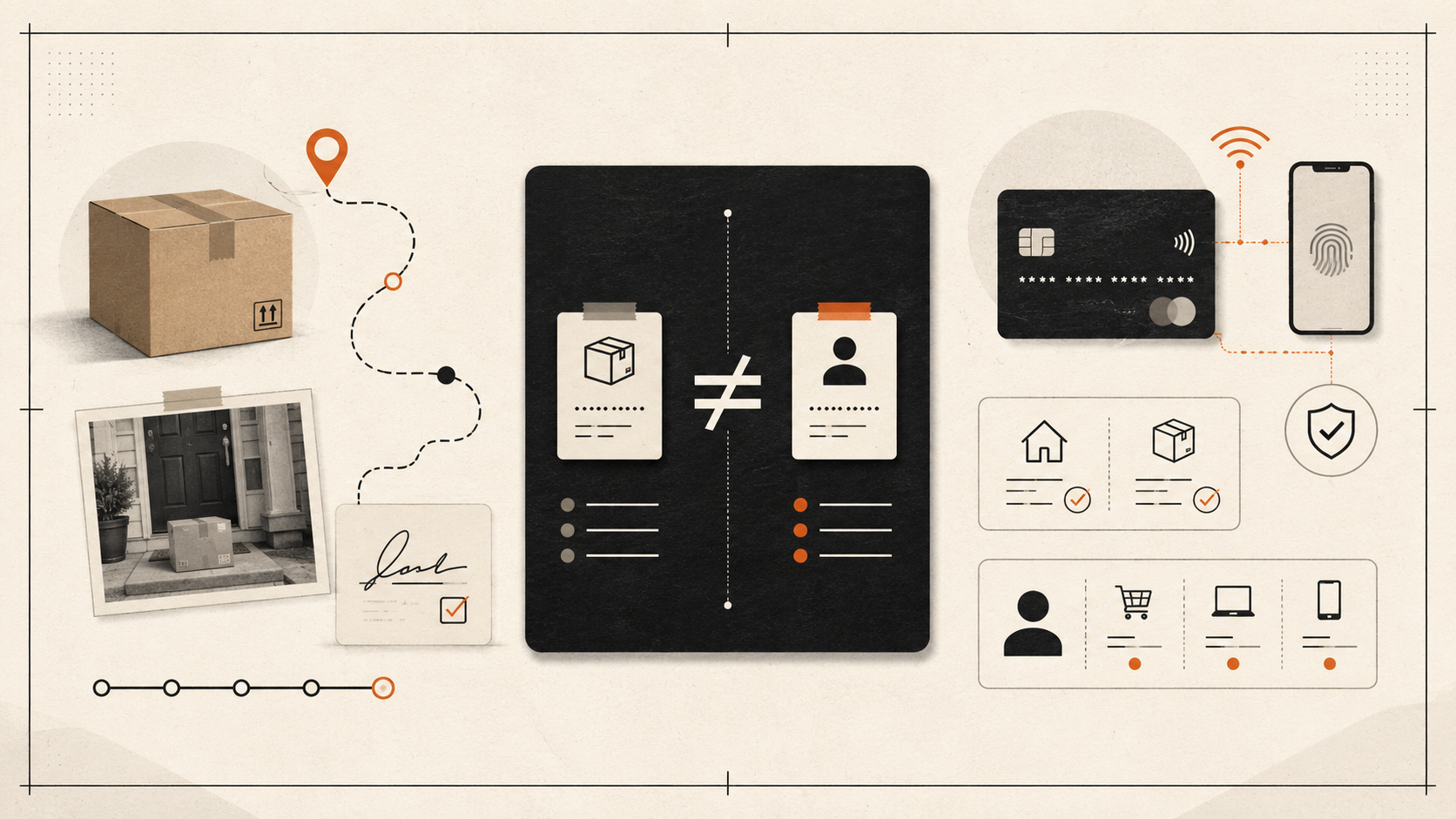
A Shopify merchant can have a tracking page, a delivery photo, a signature, and a long email thread—and still lose a chargeback.
That does not always mean the evidence was useless.
Sometimes the evidence answered the wrong question.
A delivery record can help establish that a parcel arrived. But an unauthorized-transaction dispute asks whether the cardholder participated in or authorized the purchase. Those are related questions, but they are not the same.
The practical lesson is simple:
The evidence should match the dispute reason.
This distinction matters because Shopify lists several chargeback categories—including fraudulent, unrecognized, product not received, product unacceptable, credit not processed, duplicate and subscription canceled—and the evidence expected varies by category.
| Dispute question | Evidence focus | What it does not necessarily prove |
|---|---|---|
| Dispute questionWas the parcel delivered? | Evidence focusTracking, carrier scans, delivery photo and signature | What it does not necessarily proveThat the cardholder placed or authorized the order |
| Dispute questionDid the cardholder authorize the purchase? | Evidence focusAuthentication, account, device, billing, prior-order and customer signals | What it does not necessarily proveThat every shipment or service issue was resolved |
Watch the 40-second Chargeback Evidence Note
Tracking can show that a parcel arrived. It does not necessarily show who authorized the purchase.
One order can create different disputes
Consider a physical-goods order that was delivered successfully.
The merchant may have:
- carrier tracking;
- a delivery photo;
- a signature;
- the shipping address used at checkout;
- customer messages sent after delivery.
That evidence may be highly relevant to a product not received dispute.
But the same order could later be disputed as fraudulent or unrecognized. In that case, the bank is reviewing a different claim: the cardholder says they did not take part in the transaction or do not recognize it.
The merchant may still include delivery evidence, but delivery alone does not necessarily connect the cardholder to the purchase.
What delivery evidence can establish
For a physical product, delivery-focused evidence can include:
- the carrier and tracking history;
- the fulfillment date;
- the delivery date and status;
- signature or photographic confirmation;
- proof that the parcel was sent to the address supplied at checkout;
- carrier notifications;
- customer messages acknowledging receipt.
This type of evidence helps answer:
Was the order delivered to the destination connected to the purchase?
For an item-not-received dispute, that is a central question.
A clean response should make the sequence easy to understand:
- The order was placed.
- The merchant fulfilled it.
- The carrier transported it.
- The parcel was delivered.
- The dispute was opened after delivery.
The reviewer should not have to reconstruct that sequence from a pile of unrelated screenshots.
What an authorization dispute asks
A fraudulent or unrecognized dispute shifts the focus.
The core question becomes:
What connects the cardholder, customer, device or prior account activity to this transaction?
Depending on what the merchant legitimately has available, relevant signals may include:
- successful 3D Secure authentication;
- billing and shipping consistency;
- IP or device information;
- prior undisputed orders from the same customer;
- account or checkout activity;
- customer communications that acknowledge the purchase;
- evidence linking the recipient of the goods to the person disputing the payment.
Not every merchant will have all of these records. A response should never imply that missing evidence exists.
The goal is not to add every possible signal. It is to identify the strongest available evidence that addresses the actual allegation.
Why more screenshots are not always stronger evidence
Merchants often collect everything:
- Shopify order screens;
- tracking pages;
- email threads;
- delivery photos;
- policy pages;
- fraud-analysis results;
- payment details;
- internal notes.
The problem is that quantity can hide relevance.
A bank reviewer may have limited time. If the strongest point is buried on page 14, surrounded by duplicate screenshots and unrelated policy language, the packet becomes harder to assess.
A stronger response usually prioritizes:
- the exact dispute reason;
- the clearest direct evidence;
- customer acknowledgment, when available;
- a short factual timeline;
- supporting records in a logical order.
The aim is not to make the packet look large.
The aim is to make the merchant's position easy to review.
A practical structure for a chargeback evidence packet
A useful packet can be organized into five sections.
1. Case summary
Keep it brief:
- dispute reason;
- disputed amount;
- order and fulfillment dates;
- delivery or service status;
- evidence-submission deadline;
- one factual sentence describing the merchant's position.
Avoid emotional language or accusations.
2. Dated timeline
List the important events in chronological order:
- order placed;
- payment processed;
- fulfillment;
- carrier scans;
- delivery;
- customer contact;
- return or refund discussion;
- dispute notification.
A timeline helps the reviewer see how the records connect.
3. Reason-specific evidence
Put the most relevant evidence first.
For an item-not-received case, this might be tracking, delivery confirmation and address consistency.
For an unauthorized-transaction case, it might be authentication, prior order history, device or account signals, and customer acknowledgment.
For a refund-related dispute, it might be the return path offered, the refund status and the communications surrounding it.
4. Supporting communications
Include only the messages that help establish a material fact.
Examples:
- the customer acknowledged receiving the item;
- the customer discussed using the product;
- the merchant offered a return;
- the customer agreed to withdraw the dispute;
- the customer confirmed the relevant account or delivery details.
Highlight the useful portion without changing the original meaning.
5. Evidence index and closing summary
End with a short list of the included records and a concise summary of what they establish.
Do not introduce new claims in the closing paragraph.
What an evidence packet cannot fix
A structured packet can improve clarity. It cannot create facts or records that do not exist.
It cannot:
- invent checkout consent;
- create a missing delivery scan;
- prove authorization when no authorization evidence exists;
- change an expired submission deadline;
- turn a policy screenshot into fraud evidence;
- guarantee that the issuer will decide for the merchant;
- replace legal advice.
Chargeback outcomes are decided by the cardholder's bank, not Shopify.
The value of the packet is therefore operational:
- identify what exists;
- identify what is missing;
- match the evidence to the reason;
- remove duplication;
- build a factual chronology;
- make the final response easier to review.
Pre-submission checklist
Before submitting, verify:
- What exact reason code or dispute category does Shopify show?
- Is the case still open?
- What is the evidence deadline?
- Does each important claim have a supporting record?
- Does the evidence answer the dispute reason?
- Are dates, amounts and addresses consistent?
- Are duplicate or irrelevant screenshots removed?
- Is customer personal information limited to what is necessary?
- Has the merchant reviewed every statement?
- Is the final file readable at normal zoom?
The takeaway
Tracking proof can be strong evidence.
But it proves a specific thing: that a shipment moved through a carrier network and may have reached a destination.
An authorization dispute asks something else.
That is why a merchant can have apparently strong delivery records and still need additional evidence connecting the cardholder or customer to the transaction.
The strongest response is not automatically the one with the most screenshots.
It is the one that makes the relevant facts clear.
Free manual pilot
Chargeback Evidence Packet by SignalCards
SignalCards is currently testing a manual Chargeback Evidence Packet workflow with three Shopify merchants who have a real open dispute.
For accepted pilot cases, the process includes:
- review of the available evidence;
- identification of missing or limited records;
- a dated factual timeline;
- a Merchant Review Copy;
- a final organized Submission Packet.
The merchant verifies every fact and submits the response themselves.
No Shopify login is required. No outcome is guaranteed.
The first three accepted cases are free in exchange for honest operational feedback.
Sources
- Shopify Help Center — Responding to chargebacks and inquiries
- Shopify Help Center — Reasons for a chargeback or inquiry
- Stripe Documentation — Dispute evidence best practices
- Visa — Compelling Evidence 3.0 Merchant Readiness
This article is for operational information only and is not legal or financial advice.
Prefer the index? Back to the SignalCards Blog.