
SignalCards Research
I reviewed 4,725 Reddit posts and found 67 business opportunities hiding in plain sight
What public complaints reveal about the products founders should build next.
SignalCards Research · May 2026 · 8 min read
Most startup ideas begin in the wrong place.
A founder opens a blank Notion page, asks ChatGPT for “micro-SaaS ideas”, scrolls through trend lists, and tries to imagine what people might buy.
The problem is that markets rarely reveal themselves as clean ideas.
They show up as complaints.
They show up in messy threads where someone says a tool is too expensive, too rigid, too slow, too complicated, or no longer fits the way their business works.
So I tried a different approach.
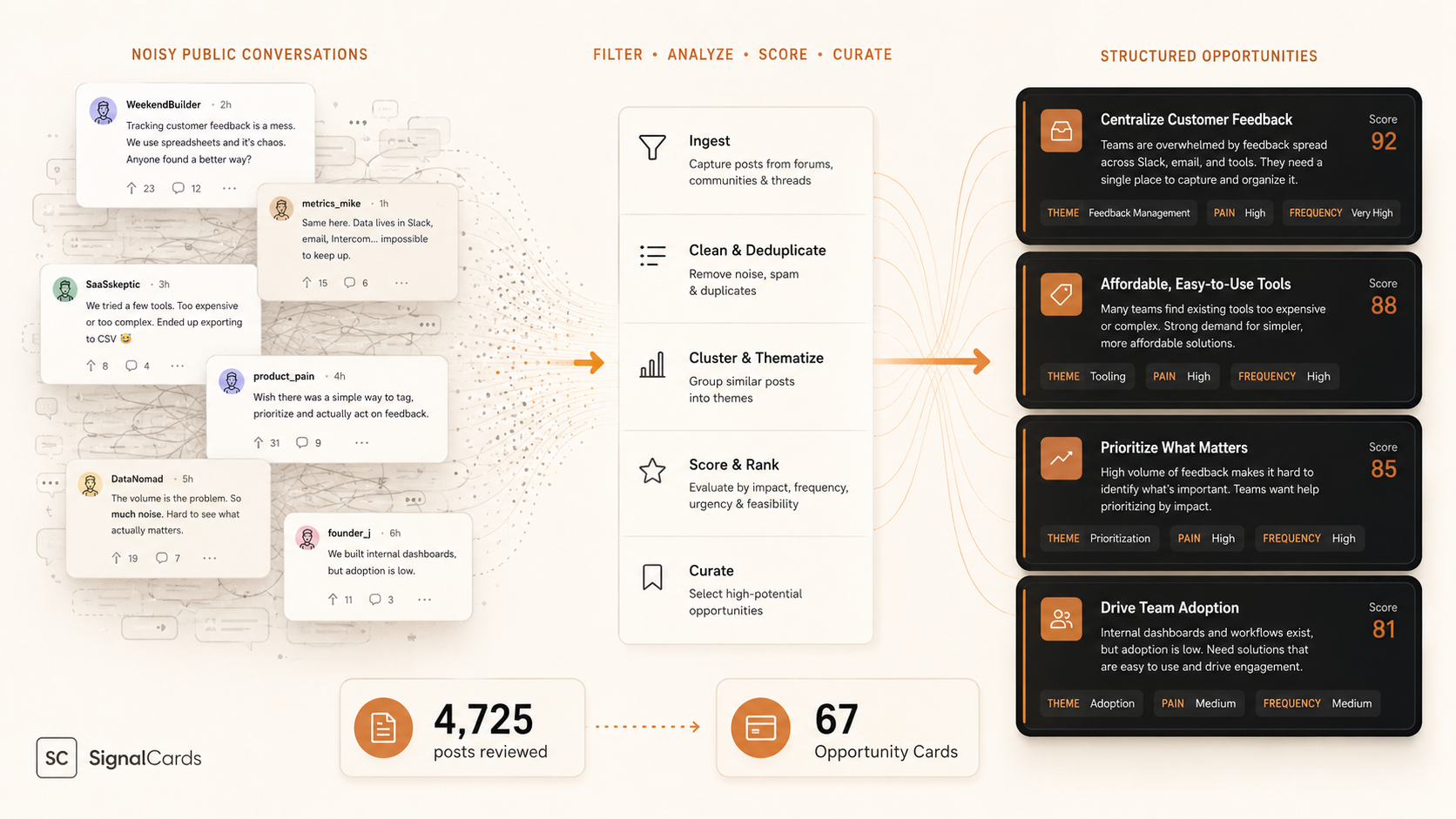
Instead of starting with ideas, I reviewed 4,725 Reddit posts and looked for signs of real market friction.
Not viral posts.
Not hype.
Not generic “what SaaS should I build?” threads.
I looked for repeated patterns:
- people complaining about tools they already pay for;
- users looking for alternatives;
- small businesses explaining why a workflow breaks;
- founders comparing tools before switching;
- agencies describing recurring client problems;
- operators asking how others solve the same issue.
From those conversations, I curated 67 Opportunity Cards.
A card is not a guaranteed startup idea. Some are product opportunities. Some are content angles. Some are competitor complaints. Some are migration signals. Some are recurring market pain patterns.
But together, they show something important:
People often describe the product they want before a founder decides to build it.
Why Reddit is useful for opportunity research
Reddit is noisy.
That is exactly why it can be valuable.
People do not usually go there to write polished testimonials. They go there to ask for help, complain, compare tools, and describe edge cases that do not fit marketing pages.
A landing page tells you what a company wants to say.
A Reddit thread often tells you what users are actually struggling with.
For a founder, consultant, agency, or growth team, those conversations can reveal:
- where existing tools are failing;
- what users are trying to replace;
- what workflows are underserved;
- what objections repeat across niches;
- what content people are already searching for.
The challenge is that most of the signal is buried inside noise.
One complaint does not make a market.
One angry user does not make a business.
One viral thread does not prove demand.
But repeated complaints, across different users and contexts, start to become interesting.
That is where the opportunity begins.
How I turned posts into Opportunity Cards
For this first SignalCards issue, I reviewed 4,725 Reddit posts across founder, SaaS, ecommerce, automation, agency, accounting, and small business communities.
The goal was not to collect “hot leads”.
It was to extract structured market signals.
Each potential signal was reviewed through questions like:
- Is there a clear pain?
- Is someone already paying for a workaround?
- Is there migration intent?
- Is the complaint about a specific competitor?
- Is the user describing a repeated workflow problem?
- Could this become a product angle, content angle, or go-to-market wedge?
The strongest signals became Opportunity Cards.
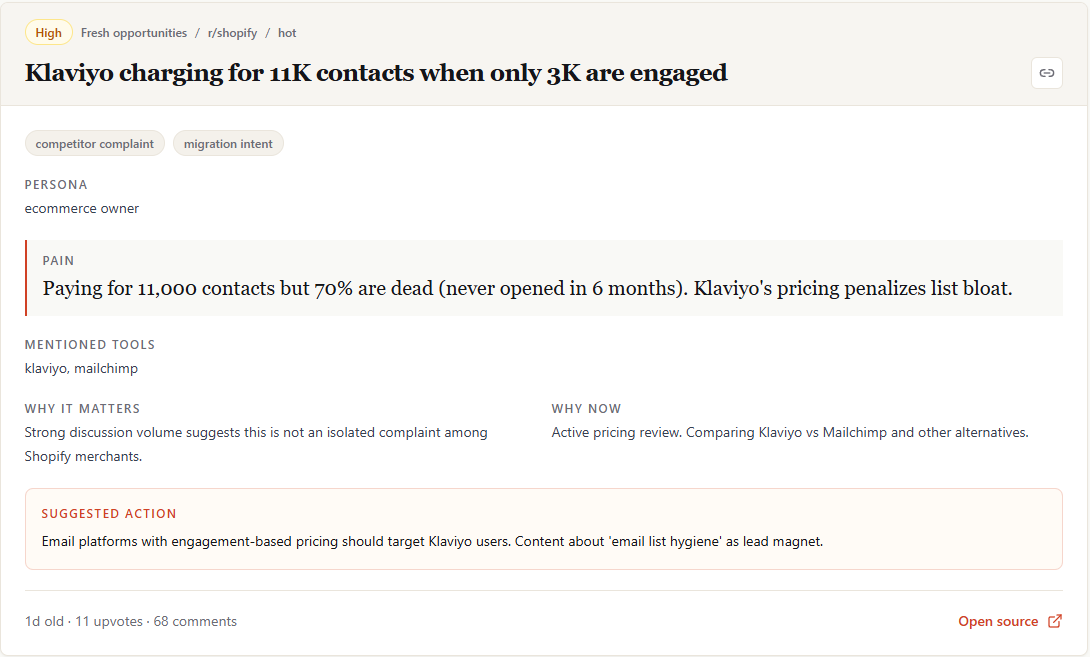
A card includes the persona, the pain, why it matters, why now, and a suggested action.
That format matters because raw Reddit links are not enough.
A founder does not just need to know that someone complained.
They need to understand why the complaint could matter commercially.
Why this is not a raw AI dump
A raw list of Reddit links is not very useful.
Most posts are noisy. Some are one-off complaints. Some are too vague. Some look interesting but do not reveal a real commercial angle.
That is why SignalCards is built as an editorial research process, not a raw alert feed.
Each card is structured around a few practical questions:
- who is feeling the pain;
- what workflow is breaking;
- why the timing matters;
- what a founder, consultant, or agency could do with the signal.
The goal is not to automate judgment away.
The goal is to make messy public conversations easier to read, compare, and act on.
That distinction matters.
A social listening alert tells you that someone mentioned a keyword.
An Opportunity Card tries to answer a better question:
Is there something here a founder, agency, consultant, or growth team can actually use?
Pattern 1: Paid complaints reveal competitor openings
One recurring pattern was users complaining about tools they already use.
That matters because a paid user complaining is very different from a random person asking for a free tool.
A paid user has already crossed the hardest barrier: they believe the category matters enough to spend money.
When that person complains about pricing, missing features, confusing workflows, or a tool that no longer fits their business, they are often describing an opening for a competitor.
One example came from ecommerce operators discussing Klaviyo pricing.
The pain was not simply “too expensive”.
The sharper signal was that merchants were paying for large contact lists while only a smaller segment was actually engaged.
That creates a wedge for competitors, agencies, or consultants:
Help merchants reduce email marketing waste, clean inactive contacts, or compare tools based on engaged contacts instead of raw list size.
The opportunity is not necessarily:
“Build a cheaper email marketing tool.”
That is too broad.
The better question is:
How can a competitor, consultant, or agency turn this frustration into a clear positioning angle?
That could become:
- a landing page;
- a comparison page;
- a sales email;
- a product feature;
- a niche service offer.
The opportunity is not always a new SaaS.
Sometimes the opportunity is a sharper go-to-market wedge.
A paid user complaining is very different from a random person asking for a free tool.
Pattern 2: Edge cases become vertical SaaS opportunities
Some of the most interesting signals were not about famous tools.
They were about workflows that break in specific industries.
A generic ecommerce platform might work well for most stores, but not for rental businesses that need availability calendars, deposits, return flows, and booking logic.
That kind of complaint is easy to ignore if you look only at broad SaaS categories.
But for a vertical SaaS founder, it is exactly the kind of edge case that can matter.
The opportunity is not “ecommerce software”.
The opportunity is more specific:
Rental-specific workflows for merchants who are forced to bend generic ecommerce tools around their business model.
These edge cases often look small from the outside.
But small, specific, painful workflows can be strong starting points for products.
A founder does not always need a massive horizontal market at the beginning.
Sometimes the better starting point is a narrow group of users with a workflow that generic software handles badly.
Pattern 3: Migration intent is stronger than general pain
The third pattern was the most interesting: people actively asking what to switch to next.
A user saying “this tool is annoying” is useful.
A user saying “what are people switching to instead?” is much stronger.
That sentence means the person has moved from frustration to action.
They are no longer just complaining. They are comparing alternatives.
Those threads are valuable because they reveal:
- what category the user already understands;
- what they dislike about the incumbent;
- what alternatives they are considering;
- what language they use when describing the switch;
- what objection a competitor should answer directly.
This is where market research starts becoming actionable.
For a founder, migration intent can inform product positioning.
For a consultant, it can reveal a service angle.
For an agency, it can become a content strategy.
For a growth team, it can expose comparison pages worth building.
I detail several migration-intent examples in the free SignalCards report.
The point is simple:
When people start comparing alternatives in public, they are often telling the market where the next wedge is.
What founders can do with these signals
I do not think founders need more idea lists.
Most idea lists are too clean.
They remove the messy context that makes an opportunity real.
A better approach is to start from market evidence:
- What are people already trying to do?
- What tools are they already using?
- Where do those tools break?
- What are they comparing?
- What words do they use when they ask for help?
- What pain repeats across different conversations?
That does not guarantee a business.
Every signal still needs validation.
But it gives you a better starting point than guessing.
It gives you something concrete to investigate.
A good Opportunity Card should help you decide what to do next:
- write a comparison page;
- test a landing page;
- interview a specific persona;
- build a narrow product wedge;
- create content around an underserved pain;
- position against a competitor complaint.
The card is not the business.
It is the starting point for better investigation.
Who I am and why I built this
I am a technical founder with a background in infrastructure, automation, and data pipelines.
Over the past few years, I have built and launched several SaaS products. That experience taught me something simple: the hard part is rarely finding “an idea”. The hard part is finding a real pain, a clear user, and a market signal strong enough to investigate.
SignalCards started from that problem.
I wanted a better way to read public conversations and separate useful market signals from noise.
Can Reddit discussions reveal market pain before it becomes obvious in keyword tools, trend reports, or competitor pages?
This first issue is my attempt to turn that messy signal into something founders can actually read and use.
I do not want SignalCards to be another generic idea generator.
The goal is to build a research product that sits closer to editorial intelligence:
- less noise;
- more context;
- more structure;
- more practical next steps.
Why I built SignalCards
I built SignalCards to turn messy Reddit conversations into structured Opportunity Cards.
The goal is not to promise hot leads.
The goal is to help founders, consultants, agencies, and growth teams see market pains earlier.
A SignalCards issue can help you find:
- product ideas;
- content ideas;
- competitor complaint angles;
- migration intent;
- recurring market pain patterns;
- tool comparison opportunities.
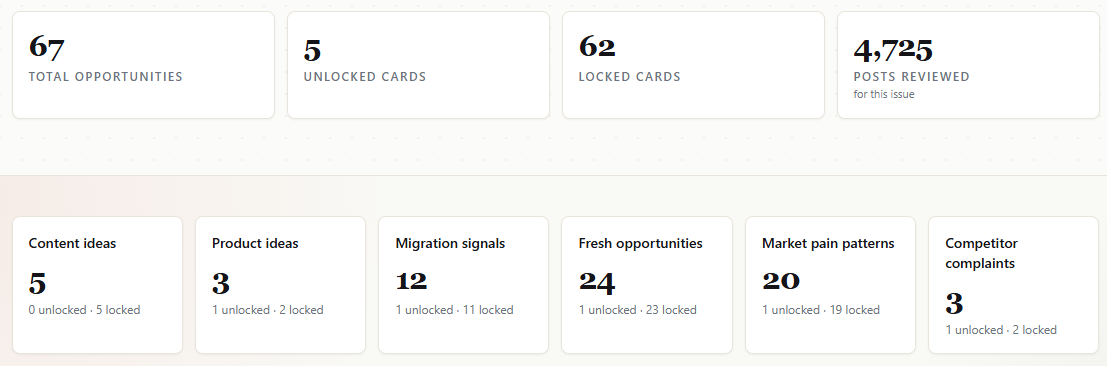
The first issue contains 67 curated cards from 4,725 reviewed posts.
The 5 free cards will show you exactly what a real market signal looks like.
If you are hunting for your next product angle, content idea, competitor wedge, or migration signal, start there.
👉 Read the free SignalCards report
Follow the build
- Website: SignalCards
- X / Twitter: @SignalCards
- YouTube: SignalCards
Read the underlying research
See the 67 Opportunity Cards behind this article
Five cards are unlocked free. The rest are available with a one-time unlock or the Monthly Intelligence subscription.
Prefer the index? Back to the SignalCards Blog.